

Structure of the Exhibition
The exhibition is organized chronologically into five sections.
1. From Post-human to Esoteric Embodiment
Drawing significant attention in the mid-1990s, Mori’s early works such as Birth of a Star (1995) and the “Cyborg” series (1994-1995) adopt elements of animé, video games, cosplay, and fashion to cast herself as a post-human female in everyday urban settings, jolting present and future, human and cyborg registers of existence. Mori’s interest subsequently expanded to Buddhist cosmology, leading to large-scale two-dimensional works like the “Esoteric Cosmos” series (1996-1998), in which she employs advanced digital imaging to stage herself in deified forms in remote landscapes based on Buddhist iconography. Designed as a kind of sanctuary, the video installation Link (2000) projects images of Mori lying inert in her transparent Plexiglas “body capsule” against iconic vistas of thirteen different sites that represent three periods of human time: antiquity, the present, and the future. Mori presents the viewer with a sense of time that defies linearity, giving form to the Buddhist concept of transmigration, wherein life and death are in constant states of mutual generation. These works mark a shift in Mori’s approach to art as a portal to expanded states of consciousness; their gorgeousness disguises her evolving belief in spiritual agency.
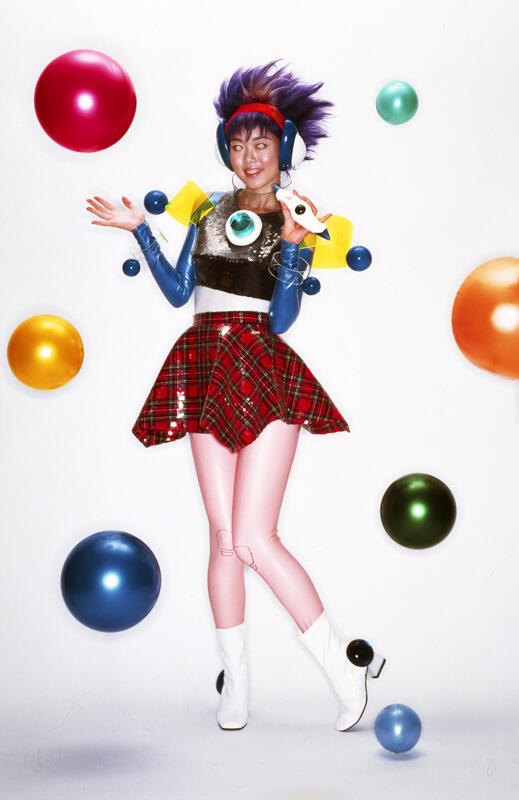
Birth of a Star
1995
3D Duratrans print, acrylic, light box, and audio CD
183 x 122 cm
Audio: 3 min. 20 sec.
Birth of a Star
1995
3D Duratrans print, acrylic, light box, and audio CD
183 x 122 cm
Audio: 3 min. 20 sec.
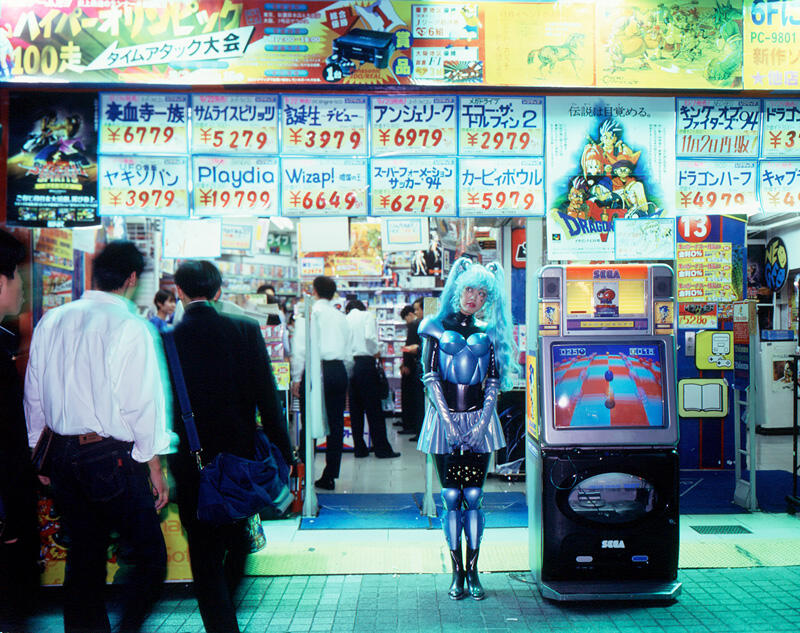
Play with Me
1994
Fuji Super-Gloss print, wood, aluminum, and pewter frame
304.8 x 365.8 x 7.6 cm
Play with Me
1994
Fuji Super-Gloss print, wood, aluminum, and pewter frame
304.8 x 365.8 x 7.6 cm
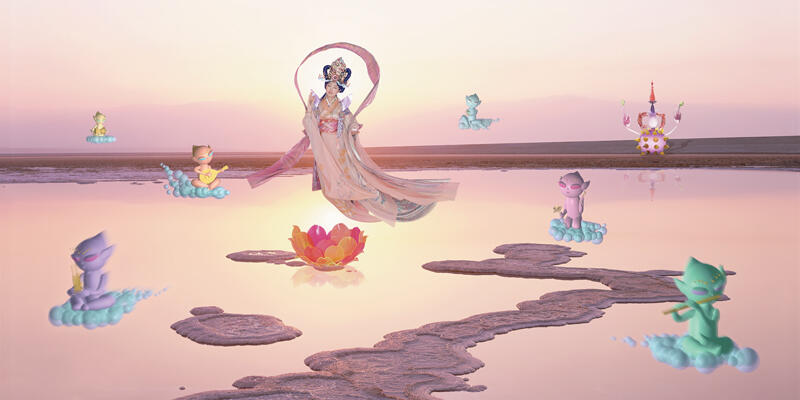
Esoteric Cosmos: Pure Land
1996-1998
Photo interlayered in glass, and stainless steel
304.8 x 609.6 x 2.2 cm
Esoteric Cosmos: Pure Land
1996-1998
Photo interlayered in glass, and stainless steel
304.8 x 609.6 x 2.2 cm
2. From Techno-spiritual Environments to “Oneness”
Mori’s interest in technology further evolved, and in her mid-career projects, she incorporated advanced computational technologies developed in collaboration with international scientists and laboratories to create techno-spiritual immersive environments. As the largest three-dimensional installation utilizing brainwave biofeedback, Wave UFO (1999-2002) is one of her most innovative works. Participants enter a biomorphic pod where their brain activity is translated into projected imagery that unites them with others. (*1) This work embodies the concept of “Oneness” - the fundamental interconnectedness of humanity - which Mori has advocated since the early 2000s in response to escalating global violence. The CG work Connected World, featured within Wave UFO, visualizes the psychic experience of deep consciousness.
*1 In the exhibition Mariko Mori: All That Shines, a limited number of visitors will be able to experience the interior of Wave UFO.
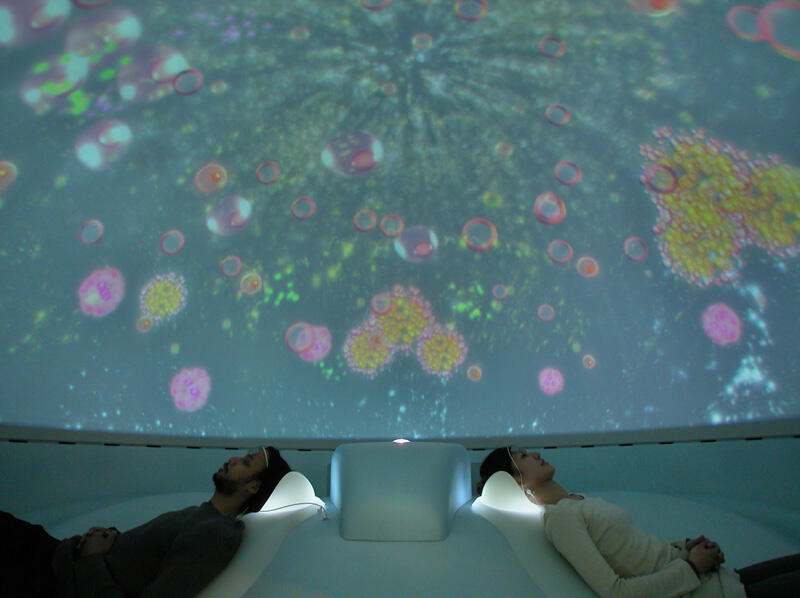
Wave UFO (interior)
1999-2002
Brainwave interface, vision dome, projector, computer system, fiberglass, Technogel, acrylic, carbon fiber, aluminum, and magnesium
528 x 1,134 x 493 cm
Photo: Tom Powel
Wave UFO (interior)
1999-2002
Brainwave interface, vision dome, projector, computer system, fiberglass, Technogel, acrylic, carbon fiber, aluminum, and magnesium
528 x 1,134 x 493 cm
Photo: Tom Powel
3. Ancient Future
Since 2004, Mori has created projects inspired by prehistoric Celtic and Jōmon cosmologies. Tom Na H-iu (2006) is a totemic sculpture illuminated by the real-time data from Super-Kamiokande, Japan’s neutrino observatory at the Institute for Cosmic Ray Research (ICRR), The University of Tokyo. Responding in real time to neutrinos generated by the sun, Earth’s atmosphere, and distant supernovae, Tom Na H-iu transforms imperceptible cosmic events into luminous flashes, connecting viewers to natural phenomena beyond the known universe. The exhibition also features photographic works of Kudaka Island in Okinawa, the Oyu Stone Circles in Akita, and other Jōmon stone circles, alongside the installation Flat Stone (2006), which emerged from her research into stone-paved dwellings of the Middle to Late Jōmon period. Incorporating motifs such as the Kamitategami-iwa rock from the Japanese myth of Onokoro Island and the Oshito stones in Kumamoto, these sculptures are components of Shrine (2025), an installation first exhibited in New York last year.
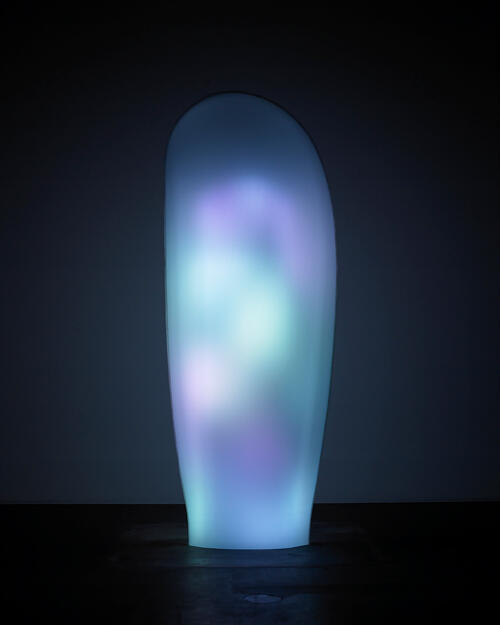
Tom Na H-iu
2006
Glass, stainless steel, LED, and real-time control system
327.4 x 115.3 x 39.6 cm
Photo: Richard Learoyd
Photo Courtesy: SCAI THE BATHHOUSE, Tokyo
Tom Na H-iu
2006
Glass, stainless steel, LED, and real-time control system
327.4 x 115.3 x 39.6 cm
Photo: Richard Learoyd
Photo Courtesy: SCAI THE BATHHOUSE, Tokyo
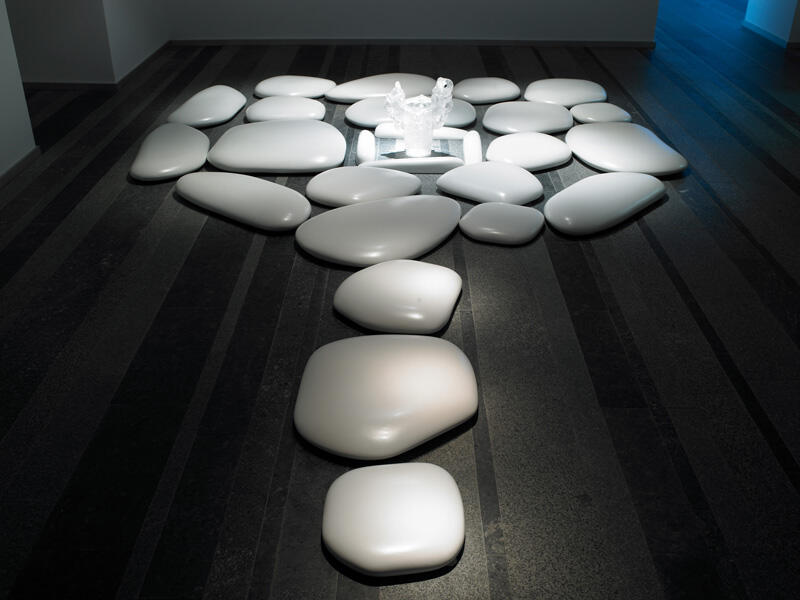
Flat Stone
2006
Ceramic and acrylic
Stones: 487.5 x 314.6 x 8.8 cm
Vase: 38.1 x 27.9 x 43.2 cm
Collection: SCAI THE BATHHOUSE, Tokyo
Installation view: Oneness, PinchukArtCentre, Kyiv, 2008
Photo: Richard Learoyd
Flat Stone
2006
Ceramic and acrylic
Stones: 487.5 x 314.6 x 8.8 cm
Vase: 38.1 x 27.9 x 43.2 cm
Collection: SCAI THE BATHHOUSE, Tokyo
Installation view: Oneness, PinchukArtCentre, Kyiv, 2008
Photo: Richard Learoyd
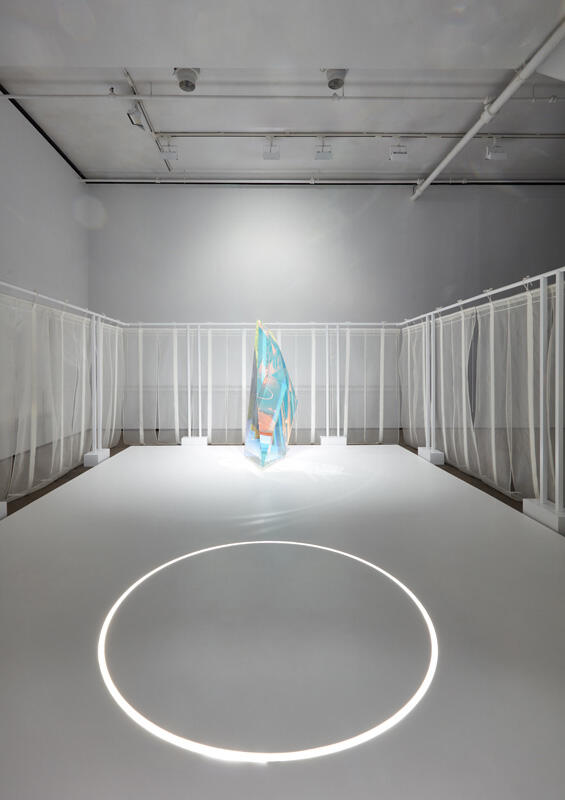
Shrine (detail)
2025
Silk, aluminum, wood, two dichroic coated acrylic sculptures, and Corian base
190 x 920 x 480 cm
Installation view: Mariko Mori: Radiance, Sean Kelly, New York, 2025
Photo: Jason Wyche
Photo courtesy: Sean Kelly, New York
Shrine (detail)
2025
Silk, aluminum, wood, two dichroic coated acrylic sculptures, and Corian base
190 x 920 x 480 cm
Installation view: Mariko Mori: Radiance, Sean Kelly, New York, 2025
Photo: Jason Wyche
Photo courtesy: Sean Kelly, New York
4. Connecting with the Natural World
The exhibition concludes with presentations of the artist’s Faou Foundation initiative. Founded in 2010 (the name “Faou” is a coined word meaning “creative force”), the foundation develops site-specific public sculptures that synchronize with the movements of the cosmos and the heavens. In collaboration with local communities on each of the six habitable continents, these projects seek to raise awareness of the Earth’s natural treasures and the relationship between nature and humanity. Following the permanent installation of Primal Rhythm: Sun Pillar on Miyako Island in 2011 and Ring: One with Nature in Rio de Janeiro in 2016, Peace Crystal, which is planned for installation in Ethiopia, was presented during the 60th Venice Biennale in 2024. This section also features a new large-scale LED video presentation capturing real events beyond the museum space, including views of Primal Rhythm: Sun Pillar, Ring: One with Nature, and the ocean seen from “Yuputira” - Mori’s studio on Miyako Island, named by combining the Miyako words for abundance (yupu) and the sun (tira).
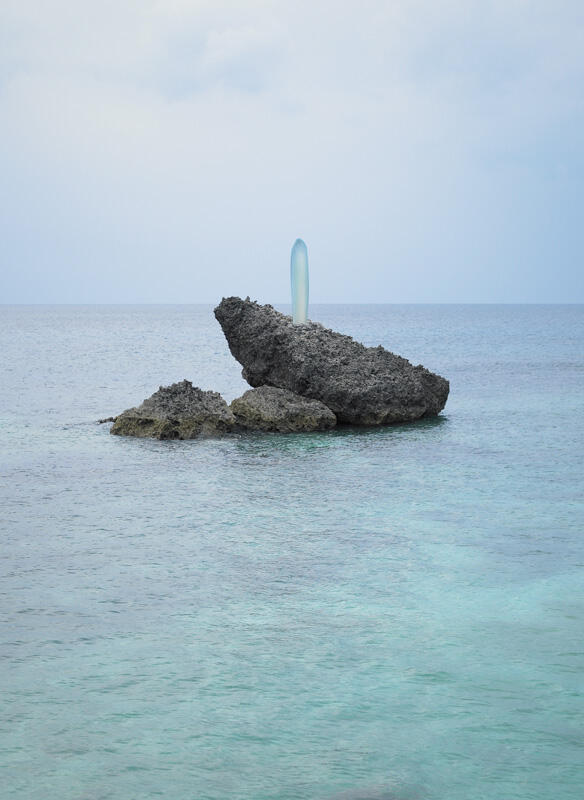
Primal Rhythm: Sun Pillar
2011
Layered acrylic, stainless steel, and concrete
420 x φ76 cm
Courtesy: Faou Foundation, New York
Installation view: Nanako Bay, Miyako Island, Japan
Photo: Richard Learoyd
Primal Rhythm: Sun Pillar
2011
Layered acrylic, stainless steel, and concrete
420 x φ76 cm
Courtesy: Faou Foundation, New York
Installation view: Nanako Bay, Miyako Island, Japan
Photo: Richard Learoyd
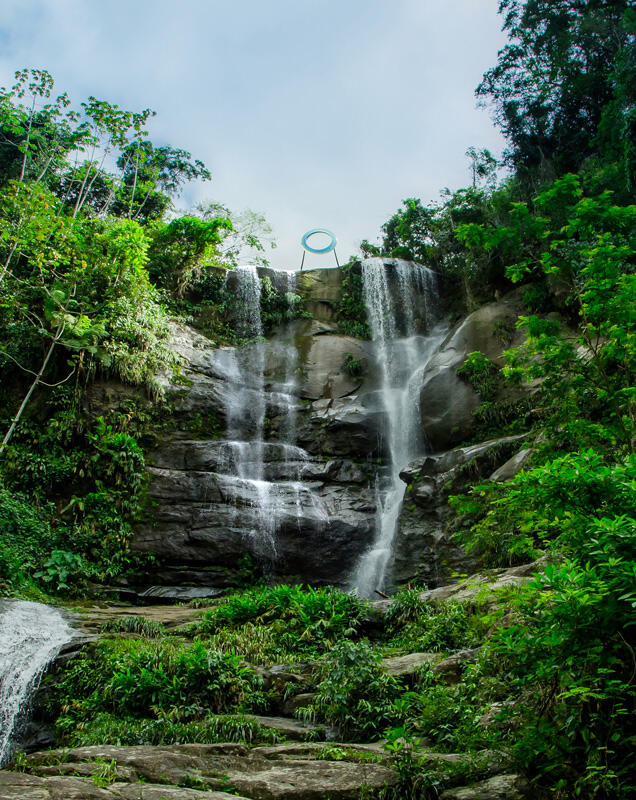
Ring: One with Nature
2016
Layered acrylic, stainless steel, and concrete
618 x φ300 cm
Courtesy: Faou Foundation, New York
Installation view: Cunhambebe State Park, Rio de Janeiro, Brazil
Photo: Stephanie Leal
Ring: One with Nature
2016
Layered acrylic, stainless steel, and concrete
618 x φ300 cm
Courtesy: Faou Foundation, New York
Installation view: Cunhambebe State Park, Rio de Janeiro, Brazil
Photo: Stephanie Leal
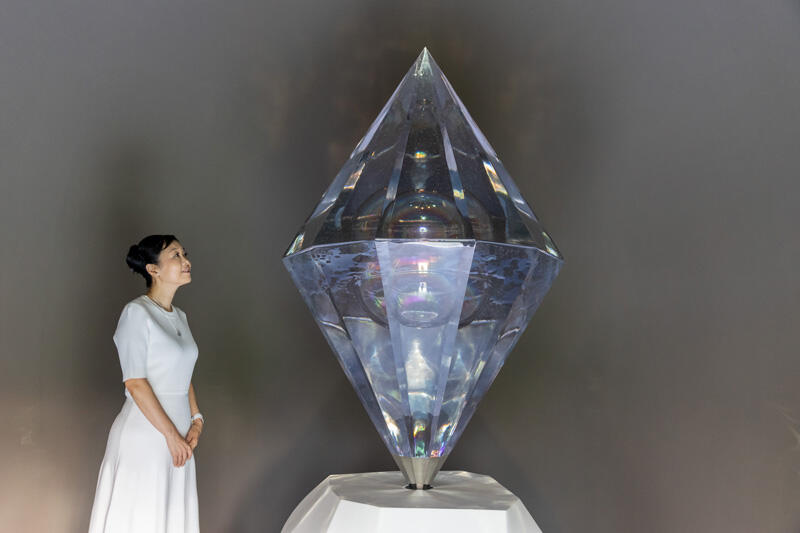
Peace Crystal
2016-2024
Crystal glass and stainless steel
167.3 x φ100.7 cm
Courtesy: Faou Foundation, New York
Installation view: Palazzo Corner della Ca’ Granda, Venice, Italy, 2024
Photo: Marta Buso
Peace Crystal
2016-2024
Crystal glass and stainless steel
167.3 x φ100.7 cm
Courtesy: Faou Foundation, New York
Installation view: Palazzo Corner della Ca’ Granda, Venice, Italy, 2024
Photo: Marta Buso
5. Mariko Mori Archive and Studio
The exhibition space includes dedicated areas for Mariko Mori’s Archive and Studio. The Archive section presents a wealth of materials, including her biography, photographs from her early modeling days, installation views, performance videos, numerous publications, and exhibition reviews. The Studio section introduces her daily practice through drawings, idea sketches, research notebooks, and books, alongside ancient objects from the artist’s personal collection.
The exhibition will be accompanied by a fully-illustrated catalogue co-edited by Alexandra Munroe and Kataoka Mami.
* Kindly note that the exhibition content and featured artworks may be subject to modification due to potential international logistical challenges or unforeseeable circumstances.