
Behind the Scenes of the Ron Mueck Exhibition: A Coordinator’s Perspective on Bringing Art to Life
2026.9.15 [Tue]
In this article, a Senior Coordinator at the Mori Art Museum takes us behind the scenes of the ongoing Ron Mueck exhibition.
This report is packed with real, insider stories that only those on-site can share—including the role of a coordinator at the museum, the secrets behind the meticulous display layout of Mass (an installation composed of 100 giant skull sculptures), and lesser-known episodes regarding safety measures.
The Role of a Coordinator
Did you know that the Mori Art Museum has a professional role called a “coordinator”? Today, I would like to introduce our work as coordinators while giving you a glimpse into the exhibition production site for Ron Mueck.
When creating an exhibition, curators focus primarily on conceptualizing the exhibition theme and selecting the artists and artworks, whereas coordinators handle various practical operations to bring that conceptualized exhibition into reality. Working together as the two wheels of a cart—each relying on the other’s expertise—and collaborating with the exhibition design and learning teams, we build a single exhibition from the ground up.
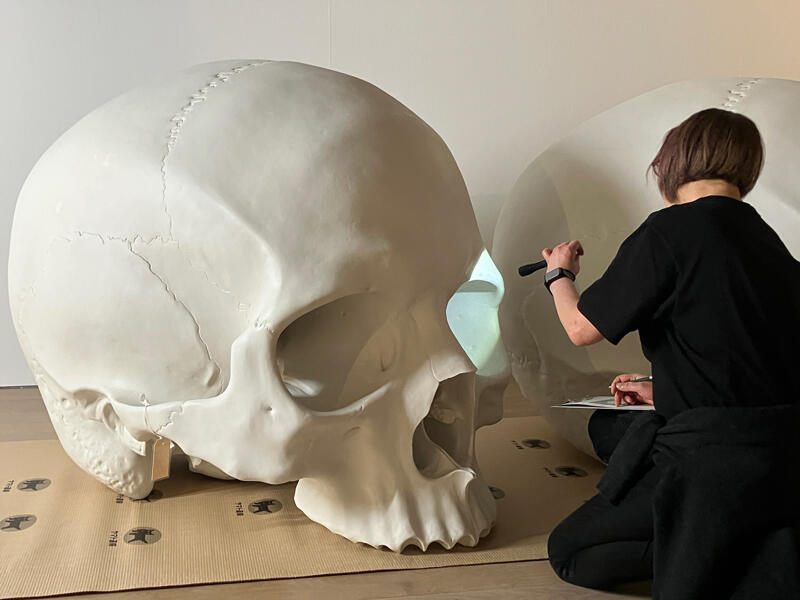
Photo: Mori Art Museum
Photo: Mori Art Museum
To give you a concrete idea of a coordinator’s duties in exhibition production, we handle everything from overall scheduling and budget management to negotiating with artists and other museums, managing loan agreements, arranging specialized art transport companies and installation contractors, supervising fabrication and display work, planning detailed setup and teardown logistics, and coordinating travel and hospitality during the stay for artists and technicians (specialized installation staff). Because we need to grasp the progress of the entire exhibition, we are also expected to serve as a hub for communication among all departments. Yes, we are incredibly busy!
Since the current exhibition is a touring show that originally debuted at the Fondation Cartier pour l’art contemporain in Paris in 2023, coordinators also managed the collaboration with the Cartier team and negotiations with the museum in South Korea, which was the tour stop just before the Mori Art Museum.
Behind the Installation of Mass
Now, out of all these duties, let me share a little bit of the backstage story regarding the installation of Mass, which can be considered the highlight of this exhibition. While the general overview of the artwork is as introduced here, what follows contains “behind-the-scenes” details. Therefore, I highly recommend reading this after you have experienced the exhibition yourself.
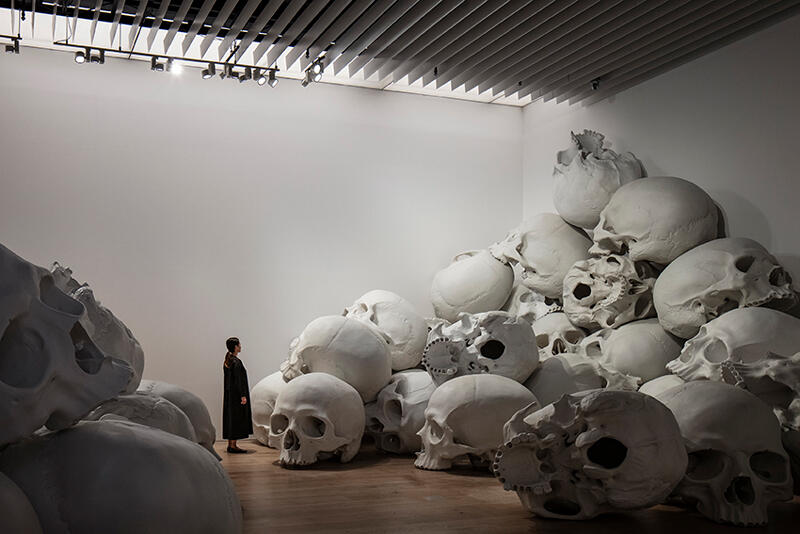
Mass
2016-2017
Collection: National Gallery of Victoria, Melbourne, Felton Bequest, 2018
Installation view: Ron Mueck, Mori Art Museum, Tokyo, 2026
Photo: Hasegawa Kenta
Mass
2016-2017
Collection: National Gallery of Victoria, Melbourne, Felton Bequest, 2018
Installation view: Ron Mueck, Mori Art Museum, Tokyo, 2026
Photo: Hasegawa Kenta
When you step into the gallery for Mass, you will encounter 100 giant skulls scattered throughout the room, looking as if a giant had carelessly strewn them about. While they may appear to be arranged at random, their placement is actually meticulously calculated by the artist. This exhibition has traveled from Paris to Milan, Seoul, and now to the Mori Art Museum in Tokyo, but the shape and size of the galleries vary at each venue.
For this reason, the artist explores the best way to showcase the work for each specific space, creating entirely different installations. For example, at the National Museum of Modern and Contemporary Art (MMCA), Seoul in South Korea, because the ceiling height is over 10 meters, some of the skulls were installed to be stacked neatly and toweringly against the gallery walls, reminiscent of catacombs in old European churches. At the Mori Art Museum, the work is designed for a 300-square-meter rectangular room, allowing visitors to wander through a “forest of skulls.” To enable visitors to observe these complex-shaped skulls from every possible angle, the orientation, angle, and layering of each piece have been meticulously determined, creating a truly dramatic scene.
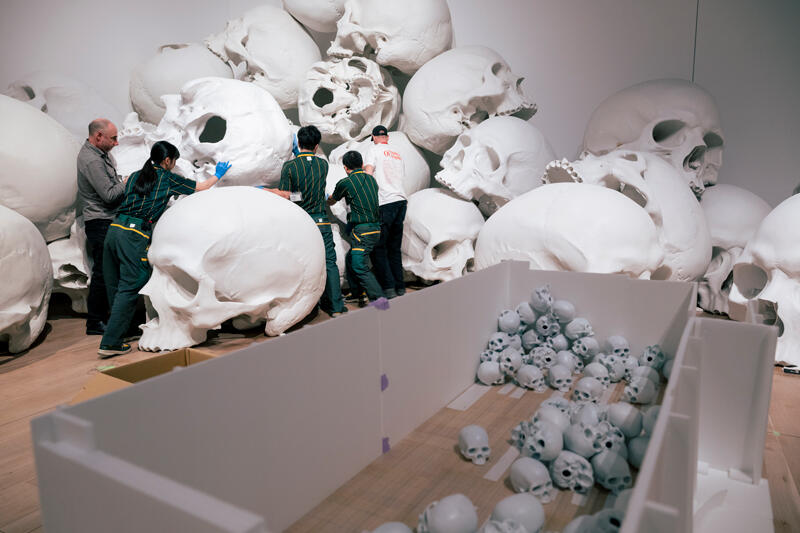
Photo: Furuya Kazuomi
Photo: Furuya Kazuomi
Because of this, the artist began reviewing the layout details using floor plans and physical models of the Mori Art Museum more than six months before the opening. Just like his artworks, Mueck’s approach to planning the installation reflects his extraordinary precision. While the artist was refining his plans, the Mori Art Museum team was busy running simulations to finalize every logistical detail, addressing questions such as how we should transport and bring in the 100 crates containing the skull works (each packed in its own wooden box), what kind of workers we need and how many, what the budget is, whether there is a safe way to stack the artworks, what equipment is required, and how we can work efficiently within a limited timeframe. There is a Japanese saying that “preparation is 80% of the job,” but for a large-scale exhibition like this, it feels more like 90%.
Filmed and Edited by: Furuya Kazuomi
Ensuring Safety Behind the Scenes
Among all these challenges, ensuring the safety of the exhibited artworks against earthquakes is an ongoing task for us when hosting exhibitions in an earthquake-prone country. For a large-scale installation like this, it directly impacts the safety of the visitors inside the gallery. Therefore, we had multiple discussions with overseas technicians who have no personal experience with earthquakes, putting a great deal of effort into helping them fully understand our rigorous approach to safety. And right during the installation period, on April 20—just after the highest skull in Mass had been put in place—an earthquake with a seismic intensity of 3 struck Tokyo. We know that even on the top floors of the Roppongi Hills Mori Tower, the building’s damping structure reduces the shaking by half.
However, when the emergency earthquake announcement suddenly blasted, “An earthquake has occurred, an earthquake has occurred,” both the technicians and our team looked up at the skulls, turning a bit pale. Fortunately, there was no need to worry; every single skull remained completely motionless. In fact, though it is not apparent at first glance, we have taken extensive safety measures, such as securing each skull to the floor or walls using unique display fixtures, tying them together with cords, inserting wedges, or placing weights inside them to ensure stability. This sudden earthquake unexpectedly proved that our preparations were absolutely flawless. Because we had prepared the groundwork so thoroughly, we were also able to implement additional safety measures. Taking care of such peace of mind and safety is also a vital part of our job. Therefore, please visit us with complete peace of mind.
In this way, stories from behind the scenes of the museum are endless, but if I tell you everything, Ron Mueck might lightly tell me off. Just as Mueck’s works invite you to do, I will wrap up my story here without revealing everything, so that you can weave your own narrative for each piece using your imagination.
Coordinators rarely step into the spotlight, but it is a deeply rewarding job where we can fully enjoy the “fun” (read: hard work) of exhibition-making—precisely because we are sweating bullets behind the scenes. The next time you revisit the Ron Mueck exhibition, try looking for where the safety measures are hidden in Mass. I pray that you won’t be able to find them!
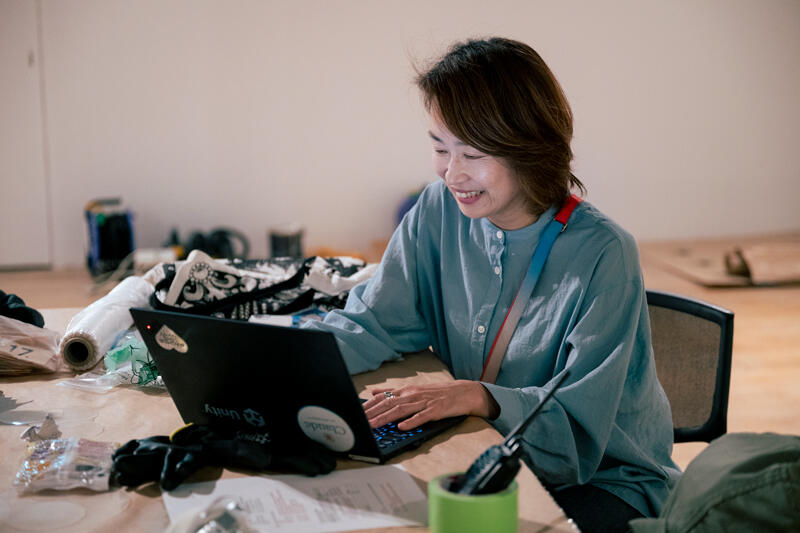
Photo: Furuya Kazuomi
Photo: Furuya Kazuomi
Text by: Tagomori Miho (Senior Coordinator, Mori Art Museum / Project Manager of Ron Mueck Exhibition)
This report is an edited version of a text originally published in the MAMC Members’ Express, an exclusive newsletter for Mori Art Museum MAMC Individual Members. As a member, you can enjoy unlimited admission to the Mori Art Museum for a full year, along with a variety of other special benefits. We welcome you to become a member and enjoy art with us!
For more details on MAMC membership, please visit: https://www.mori.art.museum/en/mamc/individual/about/